Showing posts with label authors. Show all posts

Saturday, June 7, 2008

The anniversary of the death of a literary light

  • Like that of Robert Kennedy, the anniversary of the death of an American who died too young occurred this past week.
Part of our collective conversation this past week has been remembering the death of Robert Kennedy, which happened 40 years ago. Kennedy, shot by an assassin in Los Angeles on the night he won the California Democratic primary, died too young. He was 42 years old.

Those who die too young provoke particular sadness.

Six decades before Kennedy was killed, on the same day that Kennedy died, American letters lost one of its brightest and briefest flames -- Stephen Crane.

Crane's one novel was the Red Badge of Courage, which contained descriptions of the confusion and terror of a Civil War battle so real that veterans of the conflict said Crane got it exactly right. Crane had never been in a battle when he wrote the book. He had been born six years after the war ended.

Crane did see action after the book was published and after he had achieved fame because of it. He took on the role of celebrity reporter for Joseph Pulitzer and the New York World when they were trying by any means to one-up their rival William Randolph Hearst and the New York Herald in covering the Spanish-American War in 1898. The World sent Crane to Cuba, and while he was there, the editors demanded "hair-raising dispatches (and) bombastic scoops on heroism," he said.

The young writer did see action and described it well, even helping fellow reporter Edward Marshall to safety when he had been shot. Crane recorded the last dispatch from the dying Marshall and filed it before he filed his own, which eventually landed him in some hot water with his editors, who accused him of disloyalty when he returned to America.

Crane quit the World and moved to England and continued to write fiction. He had come under heavy criticism from proper Victorians because of his choice of a mate -- a former brothel keeper from Miami who helped him run up massive debts while in Europe. Crane faced a tougher foe than critics or bill collectors, however. He contracted tuberculosis and spent his last months in a desperate attempt to find relief.

That attempt failed, and on June 5, 1900, he died. He was 28 years old.

__________

(Much of the informtion here about Crane's journalism comes from
Denis Bryant, Pulitzer: A Life, John Wiley, 2001.)

Sunday, May 25, 2008

The audacity and hope of Barak Obama, the writer

  • Barak Obama wrote his own book -- no ghostwriters or co-authors. He did the literary heavy-lifting himself.

It was with plenty of audacity and no small amount of hope that Barak Obama sat down in the early 1990s to write his life story.

He had just turned 30 in 1991 and could reasonably assume that much was ahead of him -- an assumption that would be true, of course -- but he also knew that his life to that point had been like no one else's whom he knew:

  • The son of a white mother from Kansas and an African father from Kenya;

  • Raised in Indonesia, Africa and Hawaii;

  • Intellectually brilliant, confirmed by the fact that he was editor of the Harvard Law Review.

Obama's defining experience to that point had been his relationship with his father, with him he had lost touch early in life and then re-established contact. Shortly after that, however, his father died, and Obama traveled to Kenya to find out more about the man. There, many of the images he had of his father are shattered. He finds that his father had slid from being a brilliant and respected academic to a drunk and an object of pity.

The small amount of fame that Obama achieved as being the first black editor of the Harvard Law Review netted him a call from a literary agent, a book proposal and a publisher. His first idea was to write about race relations, but that didn't suit him and where he was, according to an article about the book by Janny Scott published this week by the New York Times.

That journey of discovery through the images he had of his father is what he decided he had to tackle. What he produced was Dreams From My Father (Amazon).

He did so with confidence and flair -- even audacity -- using composite characters, invented dialogue, out-of-sequence events and a variety of literary techniques. He has since come under some criticism for his account. Inquiring journalists and political opposition researchers say things didn't happen the way he said they happened.

But there is one fact that no one disputes. Obama wrote his own book.

He struggled with sentences, phrasing and structure. He edited, rewrote and rethought.

The words are his and his alone. He didn't pay a ghostwriter or take on some partner to do the literary heavy-lifting. The writing is his creation. In this age of spin and carefully calibrated public pronouncements, getting an unobstructed look into the mind of a prominent political figure does not happen very often.

Obama wrote his own story. In my book, that counts for a lot.

Links:

Wednesday, April 30, 2008

The Invention Conceit

  • In our modern Scots-invented world of bloviation, headlines and titles can't stand the heat of a literalist's kitchen.

Being a literalist when it comes to words and their usage (though not without a sense of humor, I hope), I tend to pay attention to headlines and titles and to parse them unmercifully.

That's why, when I got my copy of Sports Illustrated last week, I was taken aback by the headline on the cover. (Yes, I get a hard copy of Sports Illustrated. It apparently comes as part of the audio subscription I have with Major League Baseball. I didn't ask for it and wouldn't buy it otherwise. I even turn down the copy of the swimsuit issue, which probably disappoints the editors because they use their highest level of sports knowledge to produce this profound epic. But I digress.)
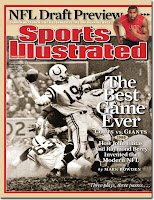
The headline on this week's issue of SI reads: The Best Game Ever. One of the subhead is "How John Unitas and Raymond Berry Invented the Modern NFL."

I'm no expert, but I know a little bit about the history of professional football in this country. I was alive in 1958 and remember listening to the Giants-Colts game on the radio in my room where I grew up in Nashville, Tenn. (It was on Sunday afternoon, and in my household at that time, we didn't watch television on Sunday.)

True, this was the first of an era of popularity of professional football that still has not run its course. And true, it was a great game with many great players. The stuff of legend, as they say. I don't quarrel with the assertion that it might have been the best game ever.

But really . . . to claim, as the subhead does, that a couple of players "invented" professional football is a bit over the top. It certainly doesn't qualify as being discrete or modest in the use of the language. In fact, it goes too far in the other direction by being splashy and overblow -- and by ultimately being wrong.

But this article, which concentrated far more on Raymond Berry than Johnny Unitas, is actually an excerpt from a forthcoming book, and it got me to thinking that this is not the first time that I have run into this "invention conceit." A quick search of Amazon reveals the following:


The list could go on, and I'm sure you get the point.
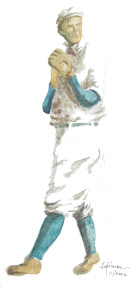
These are probably all terrific books. I have read only one of these books: Frank Deford's book on John McGraw and Christy Mathewson. It was okay though in the end disappointing because Christy Mathewson died early and for some very wrong reasons. He was from all accounts a truly fine person and did not deserve his fate. (BSP alert: The watercolor of him at right can be found at First Inning Artworks.)

But nowhere in the book does Deford really make the case tht McGraw, Mathewson and the Giants invented modern baseball. How could he? It is a ludicrous argument to embark on in the first place.

By the same token, I'm pretty sure that the Scots did not invent the modern world. Don't get me wrong. I love Scotland. I lived their for several months once. At no time did I hear any Scot bragging about inventing the modern world. The Scots do brag about inventing golf. I'll give them that one.

Herbert Matthews, I'm confident, did not invent Fidel Castro. If he did, he has a lot to answer for. The Jews didn't invent Hollywood, Mary Rogers and Edgar Allen Poe didn't invent murder (that one goes to a guy named Cain) and Harold Robbins didn't invent sex. I know I'm on solid ground with that last one.

The only one I'm willing to concede is the last one: Arthur Conan Doyle probably did create Sherlock Holmes.

Because that's what authors do.

Updated May 4, 2008.